
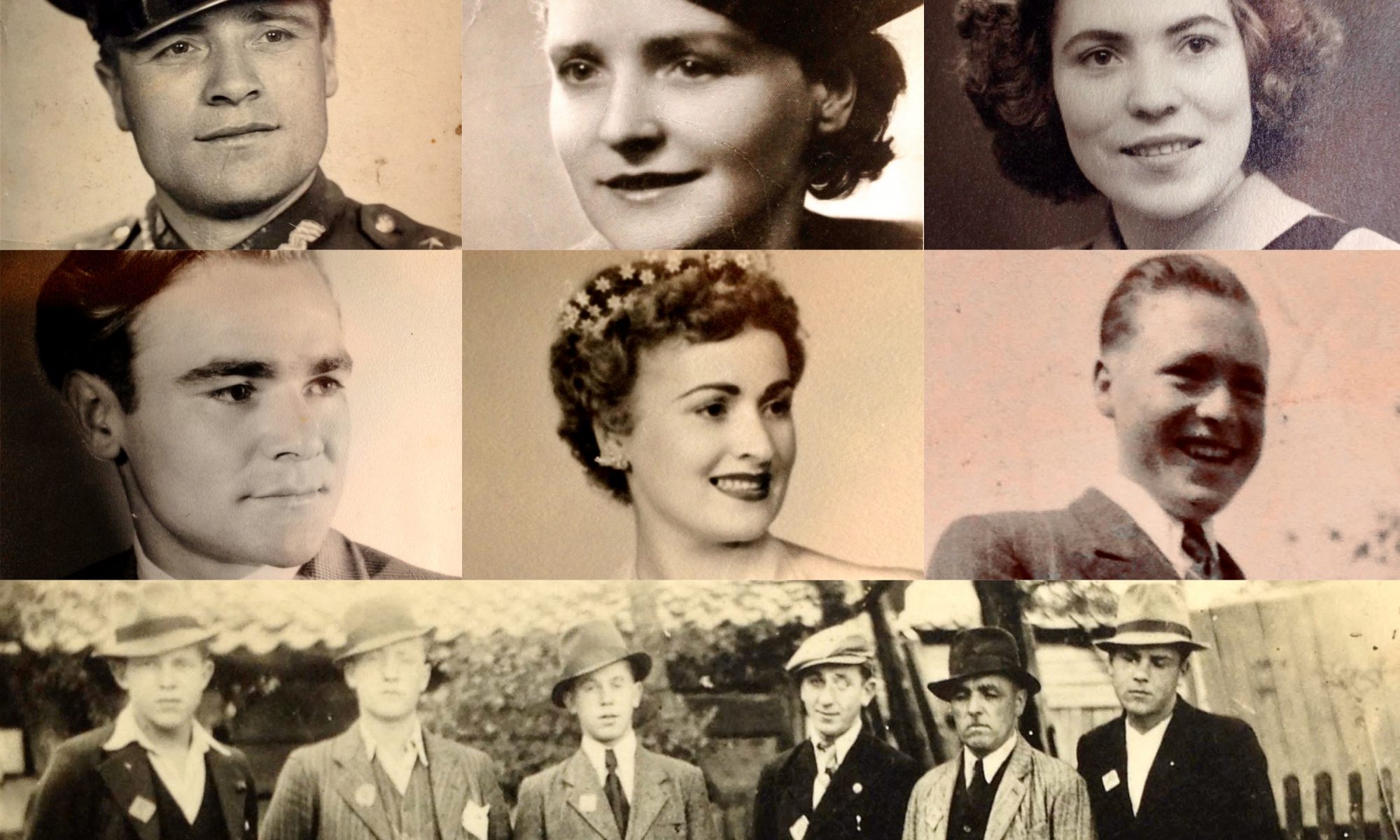
Gawel Family (click to see tree)
It was a simple place. The kind of place where if change came, it came slowly -if at all. Political ideas from capital cities were as distant here as the visitors who would occasionally bring them. Visitors saw wooden floors under tin roofs and dusty windows inside small rooms all overlooking fields of grain. It was a simple place with animals, of course —cows, horses, pigs and yes, geese on a land flat and wide where it met the horizon in a straight line.
Travel along the dirt road and by chance you may see my grandmother toiling with the laundry or planting a pot of flowers. Katarzyna kept house for her family, and she worked the farm hard. After all, this was her life now.
Katarzyna probably came here with Jozef as an opportunity for a better life as a Pole, even though the White Russians lived here too, and really, it was historically their land. Josef and Katarczyna were Polish “Osadniks” – former military families who were given or sold state land in the Kresy (territory ceded to Poland by Polish-Soviet Riga Peace Treaty of 1921).

The children worked the land in February of 1940. There were six of them: Tadeusz (Teddy) b. 1920, Gienia (Jen), Wladyslawa (Wladja) b. 1926, Francisek (Frank) b. 1928, Zosia (Sophie) b. 1932, and Czes (Chester) b. 1935. They all had jobs on the farm. Teddy, a strong young man now, helped the most, while the younger took on lighter work. Jen helped her mother keep the house, while Wladja watched the geese.
Chores mattered, but the children mattered most of all to my grandmother. Katarzyna protected her children wildly— even from the abrasive demands of grandfather who demanded so much from all of them. This was their life, and yes, they all existed on a 1940 Eastern Poland farm, where the closest town was “White Russian” Drohiczyn.
They were all born within the agrarian Colony Kursunie (Korsun) near Drohiczyn – this family of six brothers and sisters in what was then eastern Poland. In February 1940, during the middle of night, the Gaweł family, along with neighbor families Strzyewski, Kulczeski and many others were evacuated at gunpoint suddenly, ripped from their little farm houses and placed on cargo trains.
Many of their kept wooden houses were burnt, including the Gawel family’s wooden home, and the Russians sent them all to the Arctic Circle gulag work camps. They went along with 1.4 million other Poles. These families found themselves near at camps within the Arkangelsk Oblast, Siberia.


John, Wladja’s son, visiting Drohiczyn
In 1940 and the first half of 1941, the Soviets deported a total of more than 1,200,000 Poles in four waves of mass deportations from the Soviet-occupied Polish territories. The first major operation took place on February 10, 1940, with more than 220,000 people sent primarily to far north and east Russia, including Siberia and Khabarovsk Krai. The second wave of 13 April 1940, consisted of 320,000 people sent primarily to Kazakhstan. The third wave of June–July 1940 totaled more than 240,000. The fourth and final wave occurred in June 1941, deporting 300,000.

to Arkangelsk February 1940
The families had to scramble to live in the camp. They were expected to pay for their food, and only bread was sustenance with meager wages. All of it was more harsh for the Gawels without a man to provide for them with better wages for cutting wood. Zosia at one point in fact became lost in the nearby woods and would have died of exposure were it not for Korsun Colony neighbors Strzyewski, Kulczeski families and others who finally found her.

We might surmise that they were near Kotlas at Camp Tiora on the southern end of Arkhangelsk Oblast. During the 1930s, Kotlas became a place to which kulaks (peasants wealthy enough to own a farm and hire labor) and osadniks were deported and made to work in the forestry industry. It was managed by the Kotlaslag division of Gulag.
Later, it hosted all possible categories of people repressed during the Stalin era. A significant population of Poles existed in the area, with whole Polish villages resettled here in 1920s and 1930s.
These families here experienced separate but similar destinies as the chaos of war caused starvation, illness, forced and accidental separations. The Gawel family, abandoned by their father because his military status, would be a death penalty for them all. The events turned, however, and this family was set out on a journey that would take them from Poland for the rest of their lives. This family survived an odyssey that separated them by pairs en route to promised refugee camps in the Middle East. It starts with politics.
Stalin was forced to release the slave laborers through the luck of geopolitics. With the Sikorski-Mayski agreement signed in 1941, Stalin agreed to declare all previous pacts he had with Nazi Germany null and void, invalidating the September 1939 Soviet-German partition of Poland and releasing tens of thousands of Polish prisoners-of-war held in Soviet camps.
Pursuant to an agreement between the Polish government-in-exile and Stalin, the Soviets granted “amnesty” to many Polish citizens on 12 August 1941, from whom a 40,000-strong army (Anders Army, later known as the Polish II Corps) was formed under General Władysław Anders.
The odyssey began, but the Gawels were treated as livestock loaded and railed toward Bukhara, Uzbekistan. The travel across Russia to Uzbekistan was fraught with dangers as the family searched and begged for food at stops along the way. Of course, this increased the risk of separation or even worse. The sisters and brothers took turns jumping off the train to search for food for everyone.
On the third day, Tadeusz leaped from the car to find bread when the train stopped at a small town. But he slipped, and his hand was cut off at the wrist by the train wheel. Tadeusz was the first to be left behind, injured and terrified. The younger ones already learned to shut down their feelings.
Older sister, Gienia, injured her leg while jumping from the train in a similar kind of accident, also forcing her to be left behind. Both Tadeusz and Gienia eventually repatriated with communist Poland. However, without the wage labor for bread at Camp Tiora near Archangel Russia, these young adults suffered the worst without their family to support them. Their destinies were now entwined with the Russians and their resources from them.

It was now only Katarzyna Gaweł and her sons Franciszek, Czesław, and her daughters, Wladyslawa and Zosia that were left to fend for themselves on the trains barreling to the Middle East. Soon, it was my mother’s turn to search for food. The family still starving. Władysława and Zosia jumped off the the train to beg for food in a small Russian city. But when they returned, the train was gone. The girls sobbed on the trainless tracks to nowhere. They were left behind while on a search for food. Everything they ever knew gone.
Wladyslawa found a police station / outpost, and thought it would be a good idea to go there. Russian soldiers there interrogated them and almost sent them to a certain abusive situation. Luckily or by the grace of God, Wladja heard Polish spoken outside, and she screamed for their attention. This brought nearby Polish soldiers inside. The Polish soldiers delivered the girls to another train destined for the Middle East, and saved them; but still, the teenage girl and her 10 year old sister were lost with only themselves to rely on.
Katarzyna, Franciszek and Czes continued forward to the Middle East. As the cargo train finally approached Bukhara, with ever weakening people, the box cars were separated to go to different places. This separated the Strzyzewski, Gaweł and Kulczeski families.
The Strzyzewski family ended up in small camp, Froza, outside of Bukhara and the Gaweł family went onto parts unknown, but most likely Persia, and the port of entry of Pahlevi, currently Bandar-e Anzali, a city of Gilan Province, Iran. Three transports over land and water delivered the Polish refugees to Persia. Katarzyna, Franciszek and Czes made it to either the first or second transport. Wladja and Zosia made it to Uzbekistan and was on the third and last transport over water to the port.
Katarzyna Gaweł protected her children desperately this far, but died of typhus near Tehran and probably was buried there in a mass grave along with countless other Polish refugees before Wladja and Zosia arrived there. The orphaned boys also were gone, and sent to South Africa as orphans to Oudtshoorn. A French naval captain were to deliver them to India, but German U-boats threatening the waters commanded another decision to go to South Africa instead, thus delivering the boys to Oudtshoorn.

The Kulczewski family was sent to Persia across the Caspian Sea, and stayed there till Hitler had his eyes on the oil fields. Those brothers were sent to Uganda. One of the brothers of Strzyzewski family ended up in a Mexican refugee camp, while the other was overland by truck, across Afghanistan, the Himalayas through Pakistan to Kolhoper India, east of Mumbai.
The orphaned Gaweł family girls arrived in India without diversion after being lost, and finally made it to Kolhoper to the little village of Balchadi, the location of a children’s camp. The Gaweł girls did not arrive until a year later after the camp was set up, the last set of children, and the most ill to arrive there. They needed a couple months of recovery time to integrate in the general camp operations.
There, however, they were separated again into different camps. At about 16 years old, my mother Wladja, was considered a young adult and was given shelter and employment with the other older children, while Zosia at 10 years was still considered too young and was administered by a Catholic youth pastor.

It is estimated that, nearly 5,000 Polish refugees from Soviet camps lived in India between 1942 and 1948, although researchers have not been able to establish the exact numbers. Multiple transit camps were set up in different locations in India for refugees who were crossing over from Iran to other places. The Maharaja’s gesture was followed by a second and larger settlement for older Polish refugees, organized in 1943. The latter camp was set up in Valivade, in what was then the princely state of Kolhapur and what is today the state of Maharashtra.


Wladja and Zosia were reunited with Bruno Strzyzewski, and eventually met Stansław Dabrowski, future husband of Zosia. At the end of war, Zosia was chosen to emigrate to the United States (USA) by way of Hong Kong, Shang Hai, and entered the USA at Honolulu, and then San Fransciso. Stanisław, also emigrated as a “sponsored” child to the United States by Fr Leonard Pluta. Zosia and Stanley became young newlyweds. They were formally educated in the USA, Stanley started a roofing business, and together, they raised two beautiful daughters.


Wladyslawa emigrated to the United Kingdom under the sponsorship of Niedbała (now renamed Kochanski 😉 the son of Katarzyna Gawełs sister). Wladja found herself in Middlesbrough, U.K for nearly a decade where she met my Dad, Albin Matylonek and married. Later Zosia and Stanisław sponsored my parents and their two children, Henry and Lucy, to emigrate to Detroit, USA in 1955 on the U.S.S. United States. The ship still exists on the docks of Philadelphia.


Of the Korusunie colony generation, Gienia, Tadeusz, Wladyslawa, Francisek, Zosia and Czes are survived by Bruno Strzyzewski of Royal Oak, Mi, and Lesiak Strzyzewski of Arlington Heights, IL.
Conversation with Aunt Theresa Mytych Gawel (Francisek’s Widow m. 1952) in Johannesburg, South Africa on November 23, 2014
Part I.
Part II.
Part III.


Nope. There are two Drohiczyns. Mom’s Drohiczyn is in current day Belarus just East of Brest. This corroborates with what mom told me.
Mom has some audio too….maybe some well edited snippets from that? Or just the whole thing. Its reality.
Get all the spelling of names correct in polish. Also, the narrative of place does not match the position of events. Archangel came two years before Uzbekistan. So it is on the farm, in cargo trains, at camp Tora at archangel and then Uzbekistan
It is on the farm, then on trains to a camp in Arkhangelsk Oblast (possibly Camp Tiora), then on trains again.
Thank you. Wonderfully put together.
We have an audio recording of mom too! I know it isn’t as eloquent
Database of people that died in Teheran
https://www.polishexilesofww2.org/lists-civilian-graves?fbclid=IwAR0cb2u3Md0wv2tD3zc9_3uHolkEoUHkLbUy4XIRP5ItYT6iWFHSBTjbJ54
Uncle Frank and Czes were with grandma in Teheran. But she also mentioned the port city. I just want to make sure grandma did die there. Starting in 1942, the port city of Pahlevi (now known as Anzali) became the main landing point for Polish refugees coming into Iran from the Soviet Union, receiving up to 2,500 refugees per day. General Anders evacuated 74,000 Polish troops, including approximately 41,000 civilians, many of them children, to Iran.